
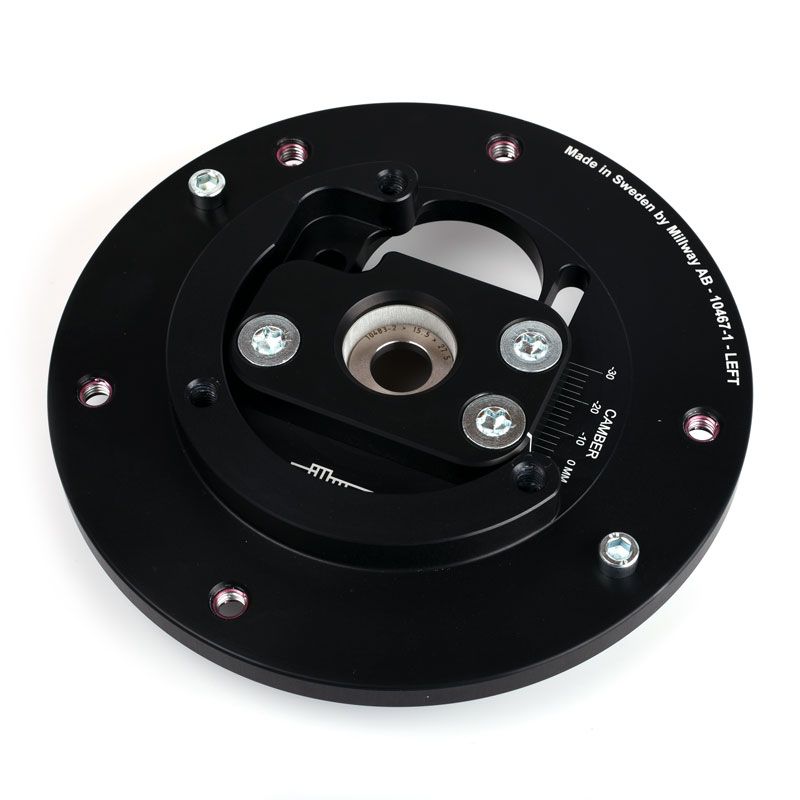
A new knock, clunk, creak or spring noise after fitting adjustable top mounts should not automatically be dismissed as "normal camber plate noise". Millway Street and Uniball camber plates replace some of the isolation found in the original BMW top mount, so a change in noise, vibration and harshness can be expected. A repeatable metallic knock, however, deserves a proper inspection.
Do Millway camber plates normally make more noise?
They can transmit more noise than the original BMW top mounts, but the amount depends heavily on which Millway version is fitted and what suspension is underneath it.
Millway Street camber plates use polyurethane bushings specifically to reduce noise and vibration compared with a solid motorsport bearing. Millway still lists increased road and suspension noise compared with the original top mount as a possible trade-off on several Street applications. In other words, a little more tyre texture, road rumble or suspension sound can be normal without there being a fault.
Millway Uniball camber plates use a motorsport-style spherical bearing to minimise deflection and maximise feedback. That gives a more direct connection between the damper and chassis, but it also removes more isolation. If refinement is important on a road car, read our Millway Street vs Uniball camber plate guide before deciding which design suits the car.
The key distinction is the type of noise. A modest increase in transmitted road sound is different from a sharp metallic knock every time one front wheel hits a bump.
Millway camber plate noise: symptom guide
| Symptom | Possible area | First check |
|---|---|---|
| More road texture or tyre noise | Reduced top-mount isolation | Confirm whether Street or Uniball plates are fitted and compare with the expected NVH trade-off. |
| Sharp knock over small bumps | Damper top nut, mounting fasteners, bearing stack, spring seating or another suspension joint | Inspect for free play and verify the complete assembly against the Millway and damper instructions. |
| Ping, twang or graunch while steering | Spring rotation, upper spring bearing or spring seat | Check the transferred OE spring bearing/plate, spring orientation and whether the spring can rotate smoothly. |
| Clunk during braking or direction changes | Top-mount fasteners, damper shaft hardware, lower arm/tension arm joints or anti-roll-bar links | Do not assume the top mount is the source. Check the whole front corner for movement. |
| Noise appeared after changing camber | Camber adjustment screws or component clearance | Verify the adjustment fasteners were tightened in the correct sequence and check clearance at the new position. |
| One-sided knock only | Local installation issue or unrelated suspension wear | Compare left and right assembly height, hardware order, spring position and visible movement. |
1. Confirm the exact camber plate and damper combination
Start with part numbers rather than assumptions. BMW F87, F8X and G8X applications use different Millway plates, and the hardware arrangement can change again when an aftermarket damper is fitted.
- F87 M2 N55: Street plate 90481-M2.
- F87 M2 Competition / M2 CS, F80 M3, F82/F83 M4: Street plate 90481-M4.
- G87 M2, G80/G81 M3, G82/G83 M4: Street plate 90530-S-M4 or Uniball plate 90530-U.
If the car has coilovers, identify the exact suspension model too. A top mount that is correct for the chassis can still require damper-specific washers, spacers, spring plates or adapters.
2. Check the damper top nut
This is one of the first areas to verify after a knock appears. On its Street camber plate instructions, Millway states that the damper nut supplied with the suspension kit should be used. The correct nut, washer stack and tightening method therefore depend on the damper manufacturer as well as the Millway plate.
Do not substitute a convenient nut because the thread happens to match, and do not copy a torque value from another suspension system. Verify the exact damper instructions. The shaft must be properly clamped without damaging the adjuster or allowing the shaft to rotate incorrectly during tightening.
A top nut that is not fully seated can allow a small amount of vertical movement which becomes a clear knock through a rigid top mount.
3. Verify the upper spring bearing and spring plate
Several Millway BMW applications reuse parts from the original BMW top mount. On 90481-family Street plates, Millway instructs the installer to transfer the original plastic spring bearing into the Millway assembly. On the G8X Street 90530-S-M4 installation, the OEM spring plate is also retained.
If the spring bearing is missing, damaged, installed incorrectly or binding, the spring can wind up as the steering is turned and then release suddenly. That often feels or sounds like a ping, twang, graunch or low-speed clunk.
Check that:
- the correct OE spring bearing or upper spring plate has been transferred where required;
- the bearing is fully seated and not cocked in the mount;
- the spring end is correctly located against its seat;
- the spring has not rotated away from its intended position during installation;
- the bearing turns smoothly with steering load rather than forcing the spring to wind up.
4. Check the bump stop and damper-specific hardware
Do not assume the original BMW bump stop is always used with aftermarket suspension. Millway's instructions distinguish between OEM and aftermarket damper setups. With original suspension, the OE bump stop may be retained; with aftermarket dampers, follow the suspension manufacturer's instructions and use the components intended for that damper.
An incorrect stack height can change where components sit at full droop and compression. It can also create unwanted contact that only appears over certain bumps.
5. Inspect the top-mount studs and chassis fasteners
On the F-series 90481 family, Millway's installation manual gives specific instructions for installing the studs into the plate, including using low torque and avoiding driving the studs through the plate. The mounting pattern also differs across applications.
Inspect all top-mount fasteners visually and physically. Look for witness marks, fretting, movement around the fixing holes, damaged threads or a stud that is not seated as intended. If a fastener has moved, simply tightening it without understanding why may hide a larger installation problem.
For G8X 90530-S-M4 Street plates, Millway specifies use of the OEM mounting screws and gives a maximum mounting torque in the current manual. Always use the current manual for the exact part rather than applying an F-series value to a G-series plate.
6. Recheck the camber adjustment bolts
If the noise started immediately after changing the camber position, inspect the adjustment hardware before looking elsewhere. For the 90481-family F-series plate, Millway's current manual instructs the installer to loosen the three adjustment screws and then tighten them in a prescribed sequence and two torque stages. The manual also warns against levering or bending tools against the plate during adjustment.
Do not treat those figures as universal Millway torque values. G8X and other designs use different hardware. Use the current instruction sheet for your exact part number.
Also check whether moving the plate inward for more negative camber has reduced clearance around the damper adjuster, strut tower opening, protective rubber cover or surrounding trim.
7. Check spring seating, preload and coilover assembly
A noise blamed on the camber plate can originate lower down the strut. Check the spring seat, helper spring, locking collars and preload arrangement against the coilover manufacturer's instructions.
Typical checks include:
- spring correctly located in both upper and lower seats;
- helper/tender spring arrangement assembled in the intended order;
- locking collars secure;
- no excessive free movement at full droop where the damper design does not permit it;
- spring not contacting the chassis, tyre, damper adjuster or another component;
- left and right assemblies built in the same order.
If a noise changes when the car is jacked up, loaded, steered or driven over a one-wheel bump, that information can help isolate where movement is occurring.
8. Öhlins Road & Track: check the correct adapter
This is particularly important because the correct interface differs between Street and Uniball setups. Millway states that its 90537-5 adapter kit must always be used when relevant Millway Uniball camber plates are combined with Öhlins Road & Track on the listed F-series, G-series and Toyota Supra applications.
For the G-series Street 90530-S-M4 setup with Öhlins, Millway's dedicated guide uses the Öhlins washer/adapter from the suspension together with the OE spring bearing and the specified Öhlins shaft nut. If an Öhlins-equipped car develops a knock after top mounts are fitted, confirming this interface should be near the top of the inspection list.
9. Do not forget the rest of the front suspension
The timing of a noise can make a new part look guilty even when it is only transmitting an existing problem more clearly. A stiffer top mount can make play elsewhere easier to hear.
Inspect the usual front-end sources as well, including:
- anti-roll-bar drop links and their mounting hardware;
- lower control arm and tension arm joints or bushes;
- track-rod ends;
- damper internal play or loose external adjusters;
- spring-to-body contact;
- brake hose, ABS lead or other hardware contacting the strut;
- undertrays, braces and strut-brace fasteners disturbed during installation.
A useful workshop test is to compare left and right while loading the suspension and steering, rather than repeatedly replacing parts based on where the sound appears to come from inside the cabin.
10. Alignment is part of the installation
Camber plates should not be fitted or adjusted without planning a proper alignment afterwards. Millway specifically warns that changing camber also changes toe. The current 90481-family manual says toe should always be adjusted after camber changes because incorrect toe can cause tyre damage and unpredictable handling.
That matters for troubleshooting too. A car that feels nervous, follows cambers in the road or suddenly wears the inside edge of the front tyres does not necessarily have a defective top mount. The alignment may simply no longer be appropriate after the camber change.
For newer M cars, our BMW G8X alignment and camber guide explains how camber and toe work together. F87 and F8X owners can use our F87 M2 and F8X Millway camber plate guide to identify the correct plate family first.
Practical troubleshooting order
- Identify the exact Millway part number and damper kit.
- Confirm all damper-specific washers, nuts and adapters.
- Check the damper top nut for correct seating and torque using the damper manufacturer's data.
- Verify the OE spring bearing or spring plate has been transferred where Millway requires it.
- Check spring seating, preload and bump-stop arrangement.
- Inspect top-mount studs, chassis fasteners and camber adjustment hardware.
- Look for clearance or contact at the chosen camber position.
- Inspect drop links, control arms, tension arms, steering joints and damper hardware.
- Road test with a technician if safe, then re-inspect for witness marks or movement.
- Complete or verify a four-wheel alignment, including toe.
When should you stop driving the car?
Do not continue normal road or track use if you can see movement at the top mount, the damper shaft is not securely clamped, a spring is incorrectly seated, a fastener is loose, the steering binds, or the knock is heavy enough to suggest metal-to-metal movement. The top of the front strut is a structural suspension connection and should be treated accordingly.
Frequently asked questions
Are Millway Street camber plates silent?
No adjustable top mount should be sold on the promise of complete OE-level silence. Millway uses polyurethane in its Street range to reduce NVH compared with the Uniball version, but its own product information notes that more road and suspension noise than the original top mount can still occur.
Are Millway Uniball camber plates supposed to knock?
More transmitted noise and vibration is expected from a solid motorsport bearing, but a repeatable metallic knock should still be investigated. Normal NVH is not a reason to ignore free play, loose hardware or an incorrect damper stack.
Why do my camber plates make a twanging noise when steering?
One possible cause is the spring winding up because the upper spring bearing or spring seat is not rotating freely. Verify the OE bearing or spring plate has been installed where required, confirm spring seating and inspect for binding. Other steering and suspension joints can produce similar noises, so diagnose rather than assume.
Do I need an alignment after fitting Millway camber plates?
Yes. Camber adjustment changes toe, so the car should receive a proper alignment after installation or any meaningful camber change.
Can I use the BMW top nut with aftermarket coilovers?
Do not choose the top nut by chassis alone. Millway tells installers to use the damper nut supplied with the suspension kit on relevant applications. Follow the damper manufacturer's hardware and torque instructions.
Do Öhlins Road & Track dampers need extra parts with Millway plates?
They can. Millway specifies adapter kit 90537-5 with the relevant Uniball camber plates and Öhlins Road & Track applications. Street configurations use a different hardware arrangement. Check the current Millway Öhlins guide for the exact chassis and plate.
Shop and compare Millway camber plates
- Millway BMW F87 M2 Street Camber Plates
- Millway BMW F8X M2 Competition, M3 & M4 Street Camber Plates
- Millway BMW G8X Street Camber Plates
- Millway BMW G8X Uniball Camber Plates
- All Millway Camber Plates
- All Millway Motorsport Products
Official Millway references
Installation details can change as products and suspension combinations evolve. The links below are the manufacturer resources used when preparing this guide. Check the latest manual for the exact part number before installation or reassembly.