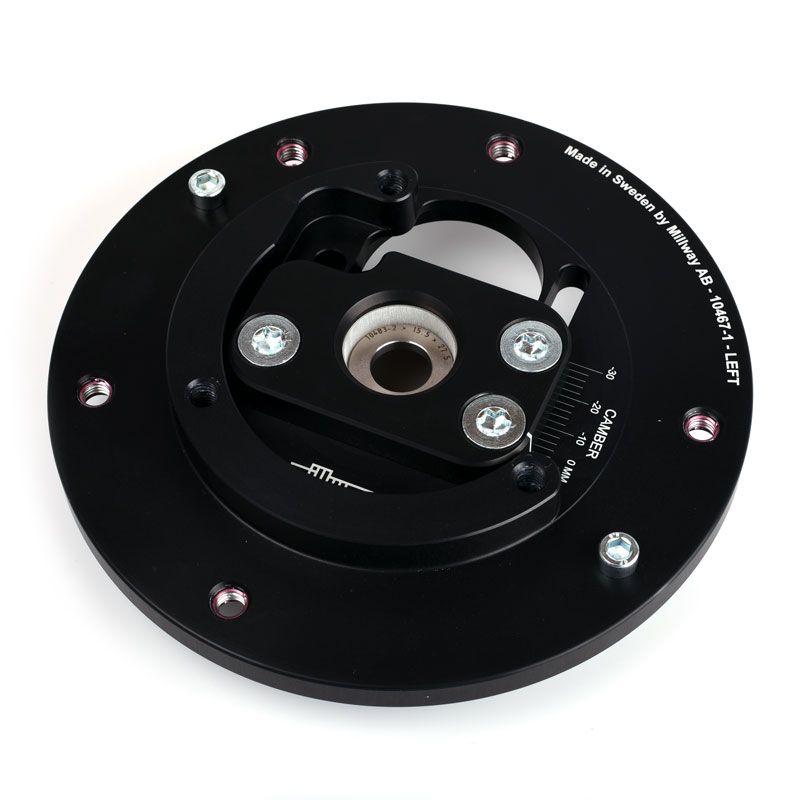

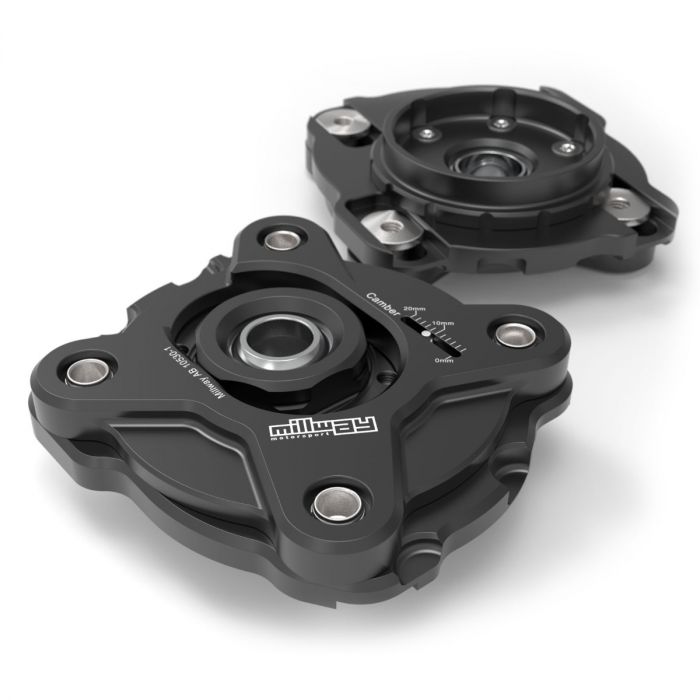
Millway Street and Uniball camber plates solve the same basic problem: they give you useful front camber adjustment where the factory BMW top mount offers little or none. The important difference is how the damper is located. Street versions use polyurethane bushings to reduce noise and vibration, while Uniball versions use a stainless-steel motorsport bearing to minimise deflection and maximise feedback.
This guide explains the trade-offs, how they apply to BMW F-series and G-series cars, and why the most aggressive option is not automatically the best option.
Millway Street vs Uniball at a glance
| Feature | Millway Street | Millway Uniball |
|---|---|---|
| Mounting | Polyurethane bushings | Stainless-steel motorsport bearing |
| NVH | Lower than Uniball, but still more direct than an OE rubber mount | More road and suspension noise transmitted into the body |
| Steering feedback | Sharper and more direct than OE | Maximum directness and minimum mount deflection |
| Best suited to | Road, fast road and mixed road/track cars | Track-focused and motorsport-biased cars |
| G8X adjustment | 0-20mm | 0-20mm |
| G8X EDC compatibility | Yes | Yes |
On the G87 M2, G80/G81 M3 and G82/G83 M4, Millway lists the same 0-20mm adjustment range and EDC compatibility for both versions. The decision is therefore primarily about refinement versus bearing stiffness and feedback, not about gaining a larger headline adjustment range.
What does a camber plate actually change?
Negative camber tilts the top of the tyre inwards. Under hard cornering the outside front tyre is heavily loaded and the body rolls relative to the road. Adding appropriate negative camber can keep more of the tyre's tread working under load, which can improve front grip and reduce excessive outer-shoulder wear on a car that is driven hard.
Camber plates move the upper strut position inboard to create that adjustment. The useful part is not simply being able to chase a large number. It is being able to set the front axle for the actual tyre, ride height, damper and use of the car.
Why choose Millway Street camber plates?
Millway developed its Street versions around polyurethane bushings. The aim is to retain the geometry adjustment and more accurate suspension location of an adjustable top mount while reducing the extra tyre and suspension noise associated with a solid bearing.
That makes Street plates particularly well suited to cars that still cover normal road mileage. A BMW M2, M3 or M4 used for commuting, weekends and several track days each year does not necessarily benefit from transmitting every small impact through a motorsport bearing.
Street is the sensible choice when:
- The car is still regularly road driven.
- You want more front camber primarily for tyre life and front-end grip.
- You use road tyres or 200TW-style track tyres rather than slicks.
- You want a meaningful geometry upgrade without making the top mounts as mechanically direct as possible.
- Noise and vibration still matter to you.
Street does not mean completely OE-like. Millway itself notes that its F87 Street plates can transmit more road and suspension noise than the factory mount. The point is that they reduce NVH compared with the Uniball version.
Why choose Millway Uniball camber plates?
A Uniball bearing removes more compliance from the upper strut location. That gives the suspension a more rigid reference point, which matters most when the car is being driven close to the limit and small geometry changes are easier to feel.
Uniball is the stronger choice when:
- The car is primarily used on circuit.
- Maximum steering feedback matters more than refinement.
- You are running high-grip tyres, aero or a more serious suspension package.
- You want to minimise movement at the top mount under load.
- Additional road noise is an acceptable trade-off.
For a dedicated track car, the question is usually not whether a solid bearing is quieter. It is whether the extra precision helps you achieve a more repeatable setup. On a daily-driven car, the calculation is different.
G8X: Street and Uniball are unusually easy to compare
The current G8X Millway range makes the comparison particularly clear. Both the G8X Street camber plates and G8X Uniball camber plates are listed with 0-20mm adjustment, stock-height compatibility, OEM and aftermarket suspension compatibility, provision for the OEM bump stop and EDC compatibility.
The Street 90530-S-M4 uses polyurethane bushings for lower NVH. The 90530-U uses a large stainless-steel motorsport bearing for maximum feedback. That is exactly how the buying decision should be framed.
F87 and F8X: make sure you buy the correct chassis version
One of the most common mistakes is treating every F87/F8X camber plate as interchangeable. They are not.
The N55-powered BMW F87 M2 built from 2016-2018 uses the dedicated Millway 90481-M2 Street camber plate. Millway lists 22mm of adjustment for this version and states that it is specifically for the N55 M2.
The F87 M2 Competition and M2 CS, F80 M3 and F82/F83 M4 use the S55/F8X 90481-M4 Street version, with 24mm of adjustment. Early F80/F82 cars can also require attention to the three-M10 versus five-M8 top-mount fixing pattern, so the physical mounting arrangement should be confirmed before ordering.
For the detailed chassis breakdown, read our BMW F87 and F8X Millway camber plate guide.
Do camber plates make a road car worse?
Not necessarily. A sensible alignment on a Street plate can make a modified BMW feel more natural because the front tyres are being used more effectively. What makes a road car unpleasant is usually the combination of excessive geometry, overly rigid hardware and an alignment chosen for a use case the car does not actually have.
The right question is not “how much negative camber can I get?” It is “how much camber does this tyre and use case need?”
Alignment matters more than the plate itself
Camber and toe interact. Millway's own F-series adjustment instructions explicitly state that toe must be adjusted after camber is changed. A car can have excellent hardware and still drive badly if the toe is left wherever it ends up after installation.
We recommend professional fitting followed by a full four-wheel alignment. For a track car, record the setup and then use tyre wear, hot pressures, tyre temperatures and driver feedback to refine it rather than repeatedly chasing somebody else's alignment numbers.
Our recommendation
For most Nineteen72 customers running a road-registered BMW with occasional or regular track use, start with Millway Street. It gives you the adjustment you actually need while retaining a degree of isolation. Move to Uniball when the car's role justifies prioritising suspension precision over refinement.
If you are building a G87/G80/G82 track car, read our BMW G8X alignment and camber guide next.
Shop Millway camber plates
Browse all Millway camber plates or the complete Millway Motorsport range. If you are unsure which plate matches your damper, spring or chassis, contact us with the full vehicle and suspension specification before ordering.