
A good BMW G8X alignment is not one magic set of numbers. The correct camber and toe for a G87 M2, G80/G81 M3 or G82/G83 M4 depend on tyres, wheel width, ride height, suspension, road mileage and how hard the car is used on circuit.
This guide gives you a repeatable way to build a G8X alignment rather than copying a screenshot from somebody else's car.
Why G8X cars benefit from front camber adjustment
The G8X platform has substantial front-end capability, but a hard-driven front tyre still sees high cornering load. On circuit, insufficient negative camber can overload the outer shoulder as the tyre rolls under the car.
For aggressive wheel and tyre packages, additional front negative camber can also be necessary for physical clearance. APEX's current G87 and G82 fitment guides specify a minimum of around -3° front camber for their most aggressive 19x11 square track fitments. That does not mean every G87 or G82 should run -3°. It means wheel fitment, tyre shape and geometry have to be considered together.
Useful G8X track examples
Published examples are useful as evidence, not prescriptions. One documented G87 M2 track build on 19x11 wheels and 305/30R19 tyres uses Millway Race camber plates with approximately -3.3° front camber, 1mm front toe-out, -2.1° rear camber and 2mm rear toe-in. Another G87 example on 295/30R19 tyres with Öhlins R&T and Millway camber plates reports approximately -2.8° front and -2.4° rear camber.
Those examples tell us that high-2° to low-3° front negative camber is a real-world G87 track envelope. They do not establish a single best setting for every tyre or driver.
A sensible G8X setup framework
| Use case | Front camber | Front toe | Rear approach |
|---|---|---|---|
| Road | Stay close to a road-focused baseline; add modest negative camber only when tyre wear or handling justifies it | Keep road stability and tyre life as priorities | Retain stable rear toe and avoid chasing aggressive numbers |
| Fast road / occasional track | Increase progressively from the road setup, then assess front tyre shoulders | Near-zero is a sensible starting philosophy before making small changes | Enough negative camber for the tyre, with rear toe-in retained for stability |
| Track / wide 200TW tyre | Published G87 examples: about -2.8° to -3.3° | Zero to a small amount of toe-out can be evaluated; one published example uses 1mm out | Published examples around -2.1° to -2.4° rear camber; retain rear toe-in for high-speed stability |
These are setup references, not BMW factory specifications and not a guarantee that your car should use those values. A 305-section track tyre on an 11-inch wheel needs a different discussion from a road car on standard wheels and Michelin Pilot Sport 4S tyres.
Step 1: decide the tyre and wheel package first
Do not set alignment in isolation. Tyre width, carcass shape, compound and wheel offset determine how much clearance and camber you can use. If you intend to move to a wider square track package, decide that before paying for a detailed geometry setup.
Also check clearance at full steering lock and through suspension travel. A setup can clear statically and still contact the liner, cooling duct or strut when loaded.
Step 2: set ride height before alignment
Camber and toe change with ride height. If you have springs, height-adjustable suspension or coilovers, establish the final ride height first. On a coilover-equipped track car, corner weighting should also happen before the final alignment.
Step 3: create enough front camber range
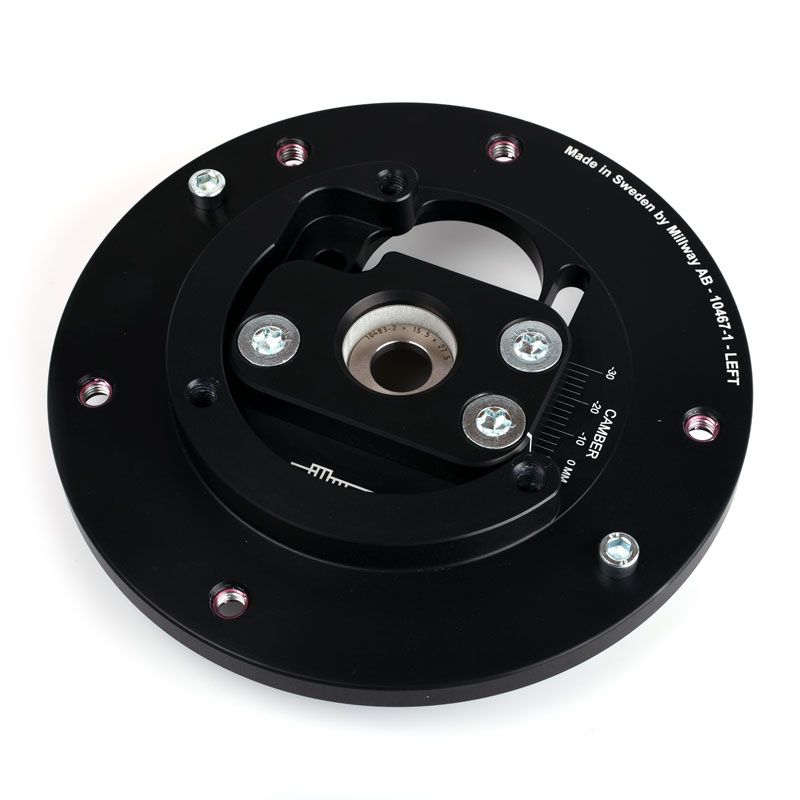
The front axle is where Millway camber plates become particularly useful. The Millway G8X Street camber plates and G8X Uniball camber plates both provide 0-20mm of adjustment according to Millway, maintain the original damper and spring height and are listed as EDC compatible.
Street uses polyurethane bushings for lower NVH. Uniball uses a large stainless-steel motorsport bearing for maximum feedback. Read our Street vs Uniball guide if you are choosing between them.
Step 4: set front camber, then set front toe
This order matters. Millway's own adjustment documentation explicitly warns that toe must be adjusted after camber. Moving the top of the strut changes the relationship between the steering arm and wheel, so the previous toe setting should not be assumed to remain correct.
For a road-biased setup, large amounts of front toe-out can make the car nervous and accelerate tyre wear. For a circuit car, a small amount of toe-out can improve initial response, but it should be added deliberately rather than appearing accidentally because camber plates were moved.
Step 5: set rear camber around traction, tyre use and ride height
The rear axle has a different job. Excessive rear negative camber can reduce the tyre's longitudinal contact patch under acceleration, while too little can overload the outside shoulder in sustained cornering. The target should therefore be based on tyre evidence and the car's power delivery as well as cornering balance.
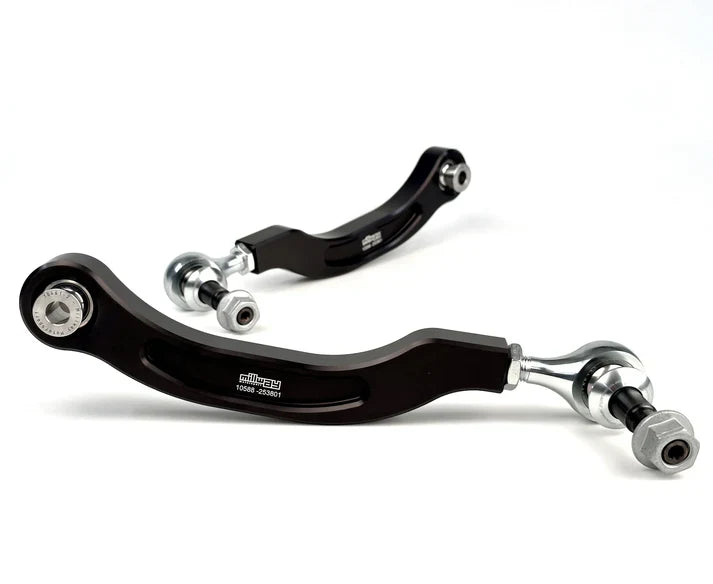
On lowered G8X cars, adjustment range and arm clearance can become limitations. The Millway 90588 adjustable rear camber arms are specifically designed with additional clearance for lowered G87 M2, G80/G81 M3 and G82/G83 M4 applications. Millway states that the adjustable length allows precise camber tuning and that the extra clearance is intended to reduce the risk of the rear suspension bottoming against surrounding components.
Step 6: rear toe is a stability setting, not an afterthought
Rear toe has a major effect on high-speed stability and how confidently the car accepts throttle on corner exit. For most road and track G8X setups, some rear toe-in is desirable rather than running the rear wheels at zero or toe-out simply to make the car rotate.
If the factory adjustment cannot achieve the required rear toe after a camber or ride-height change, an adjustable toe link may be required. Millway's 90460-1 rear toe link is listed for both F8X and G8X M2/M3/M4 and is specifically described by Millway as useful when extra camber requires the toe to be brought back to the correct range.
Step 7: use tyre data to refine the setup
A geometry sheet tells you what the car measured on the alignment rig. It does not tell you whether the tyre is working evenly on circuit.
After the first proper track sessions, record:
- Cold and hot tyre pressures.
- Inside, centre and outside tyre temperatures where you have a repeatable measurement method.
- Outer-shoulder wear.
- Inner-shoulder wear during road mileage.
- Corner entry response.
- Mid-corner front grip.
- Rear stability under braking and throttle.
If the outside front is consistently hotter and more worn, additional negative camber may be warranted. If the inner shoulder is taking a beating during road use and the car is not using the outside of the tyre on track, you may have gone too far.
Do not chase symmetry blindly
The goal is not to make every number look visually perfect on a printout. Small side-to-side differences can come from driver weight, ride-height variation, chassis tolerances and the surface the car is measured on. What matters is that the final setup is intentional, repeatable and appropriate for the car.
What we would do for a dual-purpose G87/G80/G82
For a car that still covers meaningful road mileage but regularly sees track days, we would normally start with the Street camber plate, create enough front negative camber to control the tyre, keep front toe conservative, retain stable rear toe-in and only add adjustable rear arms when the required geometry or lowered ride height demands them.
For a dedicated track car on very high-grip tyres, Uniball front mounts, more aggressive front camber and adjustable rear geometry become much easier to justify. The alignment should then be treated as a test variable, not a one-time number.
G8X suspension links
Browse BMW G87 M2 suspension, BMW G80 M3 suspension, BMW G82/G83 M4 suspension, all Millway camber plates or the complete Millway Motorsport range.
Safety and setup note
Alignment settings directly affect vehicle stability, braking behaviour and tyre wear. Values in this article are examples and setup ranges, not manufacturer specifications for your individual car. Suspension parts should be professionally fitted and the completed car aligned by a competent specialist. Recheck fasteners and alignment after initial use in accordance with the component and suspension manufacturer's instructions.