
BMW G8X brake squeal is one of the most common complaints associated with the latest M cars. Owners of the BMW G80 M3, G81 M3 Touring, G82 M4 Coupe, G83 M4 Convertible and G87 M2 often notice a high-pitched squeak or squeal from the brakes, particularly at low speed, when the brakes are cold, after washing the car, or during light pedal applications around town.
The important point is that a squealing BMW M brake does not automatically mean the brake system is faulty. BMW itself explains that high-performance M Compound and M Carbon Ceramic brake systems can generate situational brake noise because of the materials and operating conditions involved. However, persistent squealing, grinding, vibration or a change in braking performance should never simply be ignored.
This guide explains why BMW G8X brakes squeal, how to tell normal performance-brake noise from a genuine problem, how to reduce BMW G80/G82/G87 brake squeak, and which pad and disc upgrades can help.
Quick answer: If your G80 M3, G82 M4 or G87 M2 only squeals during light, low-speed braking, especially when cold or wet, the cause is often pad and disc vibration rather than a failed component. Correct bedding, cleaning and a more road-biased pad compound can reduce the problem. If the noise is permanent, comes with grinding, pulsing, pulling or reduced braking performance, inspect the brakes before driving further.
BMW G8X brake squeal guide contents
- Why do BMW G8X brakes squeal?
- Is G80, G82 or G87 brake squeal normal?
- Common causes of squeaky BMW M brakes
- What to try before replacing parts
- Best brake pads for reducing G8X brake squeal
- When brake discs are part of the problem
- Road pads vs track pads and brake noise
- How to bed BMW G8X brakes correctly
- BMW G8X brake squeal FAQ
Why do BMW G8X brakes squeal?
Brake squeal is usually caused by high-frequency vibration within the pad, disc and caliper system. When the frequency enters the audible range it becomes the familiar sharp squeak heard during braking. This can happen even when the pads and discs still have plenty of material remaining.
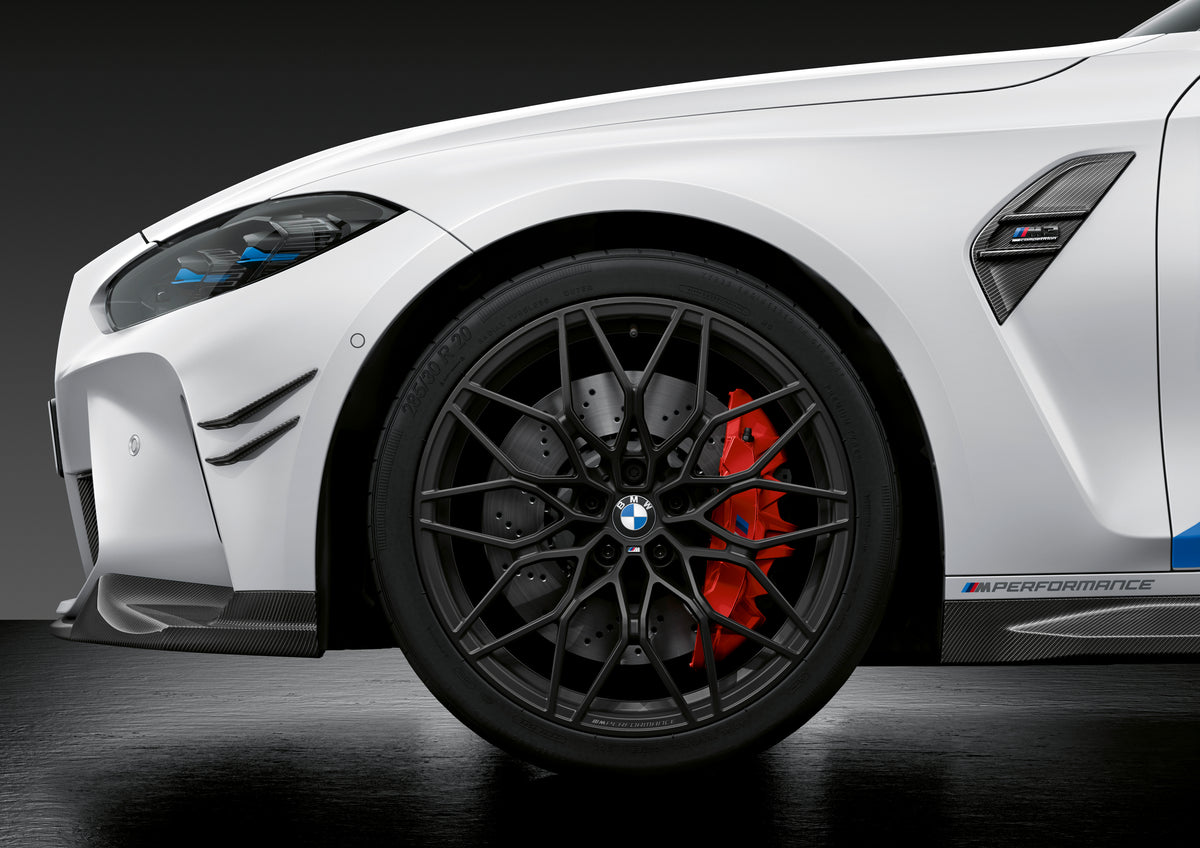
The G80 M3 and G82/G83 M4 use powerful M braking hardware designed to cope with repeated high loads. BMW's M Compound system uses large front fixed calipers and substantial iron discs, while M Carbon Ceramic brakes are available on selected models and specifications. The G87 M2 uses closely related high-performance M braking hardware. That performance focus means the system is capable of generating more noise than a softer, comfort-biased brake setup.
BMW specifically notes that its M Compound and M Carbon Ceramic brakes can develop noise under certain operating conditions. In other words, a brief squeal from an M3 or M4 at low speed is not automatically evidence of a defect. You can read BMW M's own explanation in its high-performance braking system technical guide.
Why performance brakes are more likely to make noise
High-performance pads have to work across a wide temperature range and maintain stable friction under heavy braking. The pad material, disc surface, caliper stiffness and contact pressure can all influence noise, vibration and harshness. A pad compound that offers excellent bite and heat resistance may therefore be less silent than a comfort-focused road pad.
This is why choosing the right pad for the way the car is actually used matters. A BMW G80 M3 that spends 95% of its life on the road has different requirements from a G82 M4 that regularly completes track days. Fitting the most aggressive pad available is not always an upgrade for a road car.
Is BMW G80, G82 or G87 brake squeal normal?
Occasional brake squeal can be normal. Persistent or changing brake noise needs investigation. The context in which the noise occurs tells you far more than the sound alone.
| Symptom | Possible explanation | Recommended first step |
|---|---|---|
| High-pitched squeal at walking pace | Pad and disc vibration during light pressure | Inspect condition, then review bedding and pad choice |
| Squeal when cold | Performance compound below its preferred temperature | Allow the system to warm naturally and assess again |
| Noise after rain or washing | Surface moisture or light corrosion on the iron disc | Dry the brakes with safe, gentle braking |
| Squeal after repeated hard braking | Heat, pad transfer or glazing | Inspect pad and disc surfaces and review bedding |
| Noise from one corner only | Uneven wear, contamination, hardware or caliper issue | Inspect that corner before assuming it is normal |
| Grinding, vibration, pulling or poor braking | Potential wear or mechanical fault | Stop treating it as normal squeal and have the system inspected |
If your BMW M3, M4 or M2 has grinding, a pulsating pedal, steering vibration under braking, pulling to one side, a brake warning, a sudden change in pedal feel, or noticeably reduced braking performance, the car needs a proper inspection.
The most common causes of BMW G8X squeaky brakes
1. Low-speed, light-pressure brake vibration
This is the classic G80 M3 or G82 M4 brake squeal complaint. The noise often occurs during parking manoeuvres, gentle stops or the final few metres before the car comes to rest. At higher braking loads the noise may disappear completely.
2. Cold brakes
Performance brake compounds are designed around heat management. Some compounds are simply noisier when cold.
3. Water and light surface corrosion
Iron brake discs can develop a visible film of surface corrosion after rain, washing or sitting in damp conditions. The first few brake applications may sound rough or squeaky while the pad cleans the disc face.
4. Poor bedding or uneven pad transfer
New pads and discs need to establish a consistent working relationship. If a new set of G8X brake pads has not been bedded according to the manufacturer's procedure, the disc can develop an inconsistent transfer layer.
5. Glazed pads or discs
Glazing occurs when the friction surfaces become unusually smooth or hardened. It can result from inappropriate temperature cycles, prolonged light braking or overheating.
6. Brake dust and contamination
Brake dust accumulation can contribute to unwanted noise around pads, abutment points and wheels. Never apply lubricant, anti-seize or dressing to the pad friction material or disc face.
7. Pad hardware, shims and contact points
Modern brake pads use carefully designed backing plates, shims and contact surfaces to manage vibration. Incorrectly installed, damaged or missing hardware can increase noise.
8. Worn, heat-affected or uneven discs
Heavy lips, heat spotting, excessive runout, thickness variation, severe scoring or an inconsistent friction surface can all make it difficult for a fresh pad to operate quietly and consistently.
How to stop BMW G8X brake squeal before buying new parts
- Confirm which brake system the car has. M Compound iron brakes and M Carbon Ceramic brakes use different components.
- Inspect pad and disc condition. Check pad thickness, disc surface condition, wear lips, cracking, scoring and evidence of uneven deposits.
- Check for contamination. Make sure the friction surfaces have not been exposed to oil, grease, tyre dressing or inappropriate detailing products.
- Check pad hardware and shims. Missing, distorted or incorrectly fitted anti-noise hardware can contribute to squeal.
- Review the bedding procedure. Follow the friction manufacturer's instructions.
- Match the pad to the car's real use. If the car is predominantly road driven, a road and fast-road compound can be a better solution than a dedicated endurance race pad.
BMW also recommends allowing new brakes time to bed in. See BMW M's brake and tyre run-in guidance.
Best brake pads for reducing BMW G8X brake squeal
If the brake system is mechanically healthy but the factory setup is persistently noisy, changing pad compound is often the most logical next step. There is no brake pad that can honestly guarantee zero squeal in every condition.
Endless MX72 Plus front pads for G80, G81, G82, G83 and G87

For a G8X BMW that is mainly road driven but still sees fast-road use or occasional track work, Endless MX72 Plus front brake pads for BMW G8X M2, M3 and M4 are one of the strongest options in our current range.
Pagid STREET+ front pads for BMW G8X

The Pagid STREET+ front brake pad set for BMW M2, M3 and M4 G8X is another strong choice for a road-biased car.
Pagid STREET+ rear pads for BMW G8X
If diagnosis points to the rear, the matching Pagid STREET+ rear pad set for BMW G8X M2, M3 and M4 gives owners the option to run a consistent road-performance compound front and rear.
Can changing brake discs stop G80 or G82 brake squeal?
Sometimes, but brake discs should not be sold as a guaranteed cure for squeal. If the existing discs are healthy, replacing them simply because the brakes make noise may achieve very little.
For G8X cars using the factory iron brake system, we offer direct replacement two-piece options including the Girodisc 380mm front two-piece brake disc set and the Girodisc 370mm rear two-piece brake disc set.
Will track brake pads make my BMW G8X quieter?
Usually, do not fit a full track pad because you want quieter brakes. Compounds such as Pagid RSL29 are excellent when the priority is repeated high-temperature braking, but they are not designed first and foremost around silent low-speed road operation.
If your G80 M3 or G82 M4 is a daily-driven car that occasionally sees spirited road use, Endless MX72 Plus or Pagid STREET+ is generally a more logical place to start when brake squeal and refinement matter.
How to bed BMW G8X brake pads and discs correctly
There is no single bedding procedure that should be blindly applied to every pad. Follow the instructions supplied by the brake pad or disc manufacturer.
What about anti-squeal paste, copper grease and shims?
Never apply grease, copper paste or anti-seize to the disc face or pad friction material. If a brake manufacturer specifies lubricant on defined backing plate or contact points, use the correct high-temperature product in the correct location and quantity.
Which BMW models does this brake squeal guide apply to?
- BMW G80 M3, including Competition and xDrive variants
- BMW G81 M3 Touring
- BMW G82 M4 Coupe
- BMW G83 M4 Convertible
- BMW G87 M2
You can browse our wider BMW G80 M3 performance parts, BMW G82/G83 M4 performance parts and BMW G87 M2 performance parts collections.
BMW G8X brake squeal FAQ
Why do my BMW G80 M3 brakes squeal at low speed?
Low-speed squeal is commonly caused by friction-induced vibration between the pad, disc and caliper during light brake pressure. Persistent noise should still be inspected for glazing, uneven deposits, contamination, worn hardware or disc condition.
How do I stop BMW G82 M4 brakes squeaking?
Start by confirming whether the car has M Compound iron brakes or M Carbon Ceramic brakes. Inspect the pads, discs and hardware, check for contamination, review bedding and make sure the pad compound suits road use.
Do BMW G87 M2 brakes squeal?
They can. The G87 M2 uses high-performance M braking hardware and can exhibit the same low-speed, cold or light-pressure squeal familiar to G80 M3 and G82 M4 owners.
Are BMW M Compound brakes supposed to squeal?
BMW acknowledges that situational brake noise can occur with M Compound brakes because of the high-performance materials involved.
Do BMW carbon ceramic brakes squeal?
Yes, carbon ceramic performance brake systems can also produce situational noise. Do not fit iron-brake pads or discs to a carbon ceramic equipped car unless the conversion has been specifically engineered as a complete compatible system.
Will new brake pads completely eliminate G8X brake squeal?
No reputable brake pad should be sold with a universal zero-squeal guarantee.
Why do my BMW brakes squeal after washing the car?
Water can leave temporary moisture and light corrosion on iron disc surfaces. The first few controlled brake applications may be noisier while the pad cleans and dries the disc.
Can brake dust cause squeaking brakes?
Brake dust can contribute to noise around the pad and caliper area, particularly when combined with moisture or contaminated contact points.
Is brake squeal dangerous?
Squeal alone is not necessarily dangerous, particularly on a high-performance brake system. Grinding, vibration, pulling, a warning light, reduced braking force, a soft or changing pedal, severe disc damage or rapidly worsening noise require inspection.
Our recommended approach for a squealing G80 M3, G82 M4 or G87 M2
If the brakes are mechanically healthy and the car is mainly road driven, start with the least invasive fix: clean and inspect the system, confirm correct bedding and make sure the pad compound suits the car's use. For owners who want a more road-friendly performance pad, Endless MX72 Plus and Pagid STREET+ are the two most relevant options in our current G8X range.
Unsure which brake pads fit your car? Send Nineteen72 Performance your registration or full vehicle specification, including whether the car has M Compound or M Carbon Ceramic brakes.
Technical note: brake components are safety-critical. This guide is intended to help owners understand common causes of G8X brake noise, not to replace a physical inspection by a competent technician.