
BMW Fitment Guide · Wheel Spacers
BMW Wheel Spacer Guide
The correct spacer size is not simply the biggest number that fits under the arch. Wheel width, offset, tyre size, ride height, camber, hub specification and bolt length all matter. This guide explains how to choose BMW wheel spacers properly for F-series and G-series cars.
Updated September 2026 · Nineteen72 Performance
What a wheel spacer actually changes
A wheel spacer sits between the wheel and hub, moving the complete wheel and tyre assembly outwards by the thickness of the spacer. A 12 mm spacer moves that wheel 12 mm further out.
The simplest way to understand the change is through effective offset. New effective offset = wheel offset minus spacer thickness. An ET30 wheel with a 12 mm spacer behaves like an ET18 wheel in terms of its lateral position.
That can improve visual fitment, create clearance between an inner wheel barrel and suspension or brake hardware, and change track width. It does not automatically improve handling. Moving the wheel out also changes scrub radius and increases leverage through the hub and bearing. Spacer selection should therefore be driven by fitment and the intended setup, not by the assumption that wider is always better.
ET30 + 10 mm
Effective offset becomes ET20.
ET35 + 15 mm
Effective offset becomes ET20.
Tyres matter
Two tyres marked the same size can have different real section widths and shoulder shapes.
F-series and G-series BMW spacers are not interchangeable
One of the biggest problems with older spacer guides is grouping every modern BMW together. The hub and bolt pattern changed on many later cars.
| Typical applications | PCD | Centre bore | Common wheel hardware | Current Nineteen72 range |
|---|---|---|---|---|
| F20/F21, F22/F23, F30/F31, F32/F33/F36, F80 M3, F82/F83 M4, F87 M2/M2 Competition | 5x120 | 72.6 mm | M14 x 1.25 | BIMECC BMW FX spacers |
| G80/G81 M3, G82/G83 M4, G87 M2, F90 M5, F97 X3M, F98 X4M and many later BMW applications | 5x112 | 66.6 mm | M14 x 1.25 | BIMECC BMW GX spacers |
The current BIMECC listings above use 60-degree taper M14 x 1.25 extended bolts. That does not mean every aftermarket wheel uses the same bolt seat. The seat profile must match the wheel. If your car has aftermarket wheels, confirm the wheel manufacturer's required bolt seat before ordering hardware.
Also note that BMW chassis codes can be misleading. F90 M5, F97 X3M and F98 X4M are F-coded cars but use the later 5x112 / 66.6 mm family, so choosing spacers by the first letter of the chassis code alone is unsafe.

Use an application-specific spacer with the correct PCD, centre bore, centre lip and wheel hardware.
How to measure the correct spacer size
There is no universal definition of a perfect flush fitment. Cars differ through wheel option, tyre brand, alignment, ride height, suspension travel and production tolerances. A size that sits perfectly on one G80 can rub on another with a wider tyre or more aggressive alignment.
- Park the car on level ground at normal ride height with the suspension loaded.
- Place a straight edge vertically against the outer wheel arch at the point where clearance is smallest.
- Measure horizontally from the outermost part of the tyre or wheel to the straight edge.
- Do not simply order that full measurement. Leave a sensible margin for tyre deflection, steering lock and suspension compression.
- Check the inside of the wheel as well. Moving the wheel out creates inner clearance, but the wheel still needs to clear the hub lip, caliper, disc hardware and any protruding fasteners.
- On the front axle, check both steering lock and suspension compression. On a lowered car, check the tyre shoulder against the liner and arch under realistic travel.
Eibach's own measuring guidance uses the same basic method: measure from the outermost wheel or tyre position to a straight edge across the arch, then choose a spacer slightly smaller than the measured gap to preserve clearance.
What size BMW wheel spacers should you use?
The table below is deliberately described as a starting point for common OEM-wheel setups, not a fitment guarantee. Always measure your individual car, especially if it is lowered, running non-standard tyres, aftermarket wheels or additional camber.
| BMW | Common OEM-wheel starting point | Notes |
|---|---|---|
| F80 M3 / F82-F83 M4 | 12 mm front / 15 mm rear | Popular OEM+ stance. Measure if lowered or running wider-than-standard tyres. |
| F87 M2 Competition | 10 mm front / 12 mm rear | A sensible conservative starting point used in our current M2 Competition stance package. |
| F20 M140i / F22 M240i | 12 mm front / 15 mm rear | Common stock-wheel arrangement. Front tyre and arch clearance should still be checked. |
| G80/G81 M3 / G82/G83 M4 | 12 mm front / 15 mm rear | Widely used stock-wheel starting point. 15 mm all round is more aggressive and is not suitable for every tyre/ride-height combination. |
| G87 M2 | 15 mm front / 15 mm rear | Common visual starting point on stock wheels. Cars with lowering or wider tyres must be measured before moving to larger sizes. |
| F90 M5 | 10 mm front / 10 mm rear | 12 mm all round is a more aggressive alternative on many stock-wheel cars. |
| F97 X3M / F98 X4M | 15 mm front / 15 mm rear | Check tyre shoulder and arch clearance carefully, particularly with non-standard tyre sizes. |
Why have we removed the old guide's long list of guaranteed sizes? Because statements such as “12 mm will fit without rubbing” are only safe when wheel, tyre, suspension and alignment are all known. The better recommendation is a measured starting point with clear fitment checks.
The spacer is only half of the installation
Extended bolts must recover the spacer thickness
For a slip-on spacer, the wheel is moved away from the hub by the spacer thickness. The wheel hardware must therefore be longer by the appropriate amount while retaining the correct thread, seat profile and safe engagement. H&R's DR-system guidance is explicit that the extended bolt thread length must correspond with the spacer thickness and the bolt collar must match the original wheel hardware.
For the BMW F and G applications covered by our BIMECC range, the common thread is M14 x 1.25. H&R's published installation data specifies a minimum engagement for M14 x 1.25 of 9 full turns, approximately 12 mm of load-bearing thread. The vehicle, wheel and spacer manufacturer's instructions always take priority where they differ.
Hub-centric does not mean “any spacer with a lip”
The spacer must locate correctly on the vehicle hub and support the wheel centrally. The inner and outer centre features need to match the car and wheel. Very thin slip-on spacers can be more complicated because there may not be enough material to create a full replacement locating lip while retaining sufficient engagement with the original hub. Do not assume a thin spacer is correct simply because the PCD matches.
Never stack spacers
Do not combine multiple spacer rings to reach a desired thickness. Eibach's installation guidance specifically warns against stacking two or more spacer rings.
When a stud conversion makes sense
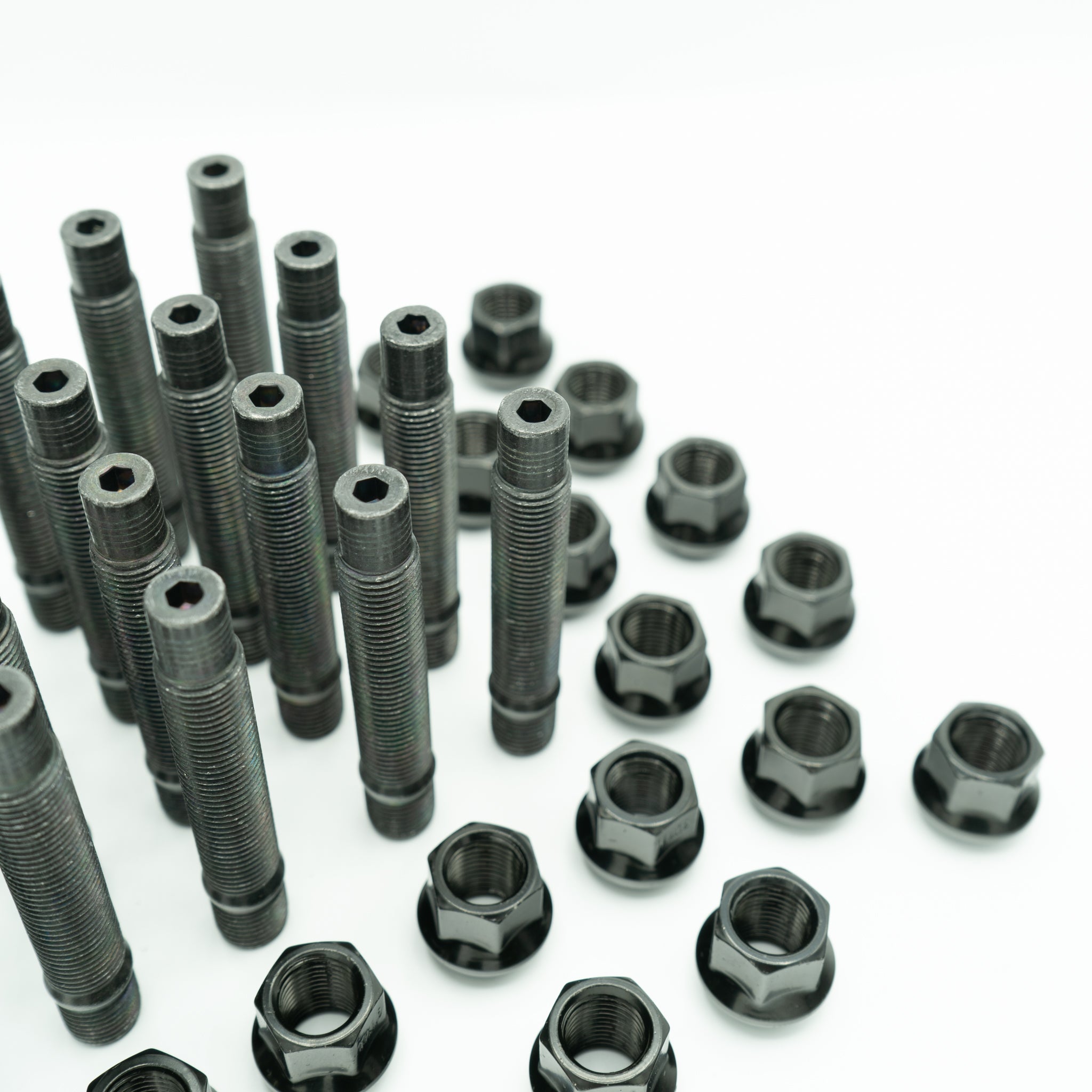
For cars that have wheels removed regularly, especially track cars, a stud and nut conversion can make wheel installation easier because the wheel and spacer are guided over fixed studs. It also gives more flexibility when choosing stud length for a known spacer setup.
Shop the BIMECC BMW wheel stud and nut conversion kit, or read our BMW stud and nut installation guide. Always select stud length around the actual wheel and spacer package.
How to fit BMW wheel spacers correctly
- Confirm the application. Check PCD, centre bore, centre lip, spacer thickness, bolt thread and bolt seat before fitting anything.
- Clean the hub and wheel mounting faces. Remove rust, corrosion and debris so the spacer sits completely flat against the hub.
- Dry-fit the spacer. It should locate without unwanted play and sit flush against the hub face.
- Check the wheel on the spacer. The wheel must locate correctly on the spacer and sit fully flush.
- Use the correct hardware. Extended bolts or correctly sized studs must preserve the required thread engagement and match the wheel's seat profile.
- Hand-start every fastener. Do not use an impact gun to force a bolt into a hub thread.
- Tighten progressively in a cross pattern. Final tightening should be carried out with a calibrated torque wrench to the vehicle or wheel manufacturer's specification and any spacer-specific instructions.
- Check free movement. Rotate each wheel and check for contact with brake, ABS or suspension components. On the front, check full steering lock.
- Re-check clearances under load. Look at tyre-to-arch and tyre-to-liner clearance with the suspension loaded.
- Re-check torque as instructed by the spacer manufacturer. For example, Eibach specifies a post-installation fastener check after approximately 25 miles and again at 500 miles for the Pro-Spacer system covered by its published instructions, while H&R specifies a re-check after approximately 100 km for its DR system. Follow the instructions supplied with the hardware you actually fit.
Do not grease wheel-bolt threads or mounting faces unless the vehicle, wheel or hardware manufacturer specifically instructs you to do so. Torque specifications are based on defined thread and seating conditions.
Why modified BMWs need more checking
Compression clearance matters
Lowering reduces the available space between the tyre, arch and liner at bump. Added negative camber may move the top of the tyre inwards, but toe and tyre shoulder shape still affect clearance.
Inspect the complete package
High lateral load, heat cycles and frequent wheel changes make hardware condition, wheel torque, stud length and clearance checks more important, not less.
After fitting spacers, an alignment is not automatically required solely because the spacer itself does not change the suspension's static control-arm lengths. However, if the car has also been lowered, had camber components fitted, or is showing uneven tyre wear, a proper four-wheel alignment is sensible. Eibach also advises checking alignment and tyre/fender clearance after spacer installation.
Common wheel spacer questions
Do wheel spacers damage wheel bearings?
A spacer increases the wheel's effective offset and therefore changes the leverage applied through the hub and bearing. A modest, correctly engineered spacer is very different from an extreme offset change, but it is wrong to claim there is zero mechanical effect. Use the smallest spacer that achieves the required fitment.
Do I need longer wheel bolts?
With a conventional slip-on spacer, yes, the hardware must compensate for the spacer thickness while maintaining the correct thread engagement and wheel seat. Use the bolts supplied or specified for that spacer and wheel combination.
Can I use my original BMW bolts with a spacer?
Not with a normal slip-on spacer unless the spacer system is specifically designed and approved to retain them. Standard-length bolts lose thread engagement by the thickness of the spacer.
Can I stack two 5 mm spacers to make 10 mm?
No. Use one correctly engineered 10 mm spacer for the application. Eibach explicitly advises against combining multiple spacer rings.
Will 15 mm spacers fit my G80 M3 or G82 M4?
They can on many cars, but the answer depends on which axle, wheel specification, tyre, ride height and alignment are fitted. Measure the individual car. Do not rely on the model name alone.
What is the difference between F-series and G-series BMW spacers?
The common F80/F82/F87 family in this guide uses 5x120 PCD and a 72.6 mm centre bore, while G80/G82/G87 and many later BMW applications use 5x112 and 66.6 mm. Some F-coded performance models such as F90/F97/F98 use the later 5x112 family, so always check the exact application.
Are wheel spacers good for track use?
They can be used on performance and track cars when the application, hardware, engagement and clearances are correct. The installation should be inspected regularly, especially where wheels are removed often. A stud conversion can make frequent wheel changes more practical.
BMW wheel fitment
Need help choosing the correct spacer size?
Send us your BMW model, year, wheel size and offset, tyre size, suspension setup and the spacer size you are considering. We can help narrow down the correct BIMECC application before you order.