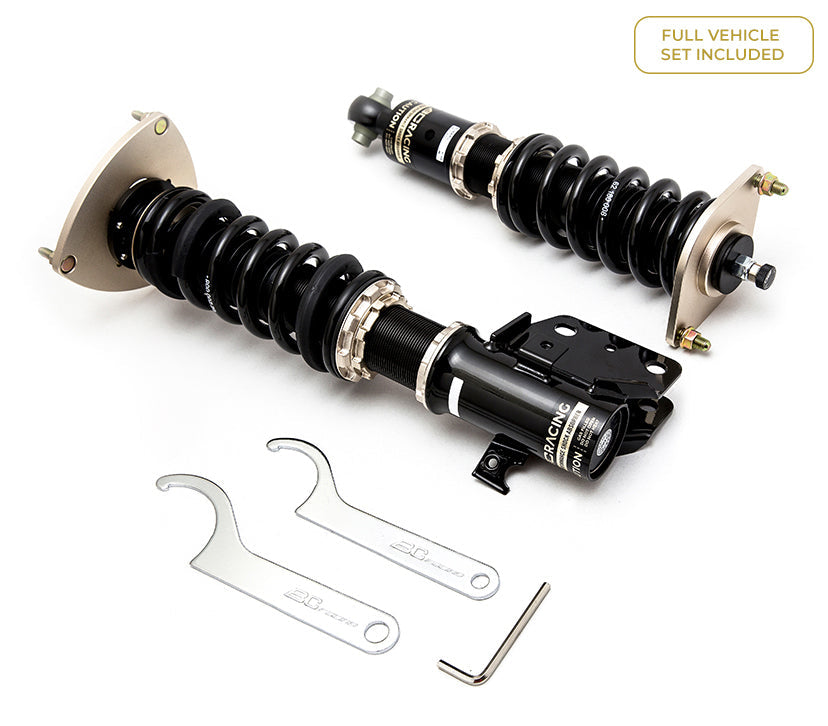

Spring rate is one of the most important numbers on a coilover specification, but it is also one of the easiest to choose for the wrong reason. A higher number does not automatically mean a faster car, and the stiffest option is rarely the best answer for a road car that also sees track days.
BC Racing develops its off-the-shelf kits around a balanced starting point for each application. Custom spring rates are available, but they should be selected around the vehicle, tyre, weight distribution and intended use rather than simply choosing the highest figure on the list.
What does a BC Racing spring rate mean?
BC Racing commonly lists spring rates in kg/mm. A specification such as 6/9 kg/mm means the front spring rate is 6 kg/mm and the rear is 9 kg/mm. The front and rear numbers should always be considered together because the balance between the axles influences how the car responds, not just how stiff it feels.
The same chassis can appear with several spring-rate combinations in the catalogue. That does not mean every option is equally appropriate for every driver. Different combinations may exist for road use, track use, extreme-low configurations, different rear suspension layouts or custom builds.
Why the standard spring rate is usually the best starting point
BC Racing states that its standard rates are chosen to balance comfort and performance for the vehicle. That makes the recommended or standard-rate kit the sensible starting point for most fast-road and mixed road/track cars.
A spring needs to work with the damper, tyre and available suspension travel. Making the spring substantially stiffer can reduce body movement, but it can also reduce mechanical grip on uneven surfaces, make the tyre work harder and move the setup away from the damper valving it was designed around.
When should you consider a custom spring rate?
BC Racing specifically positions custom rates for builds with a reason to move away from the standard setup. Typical examples include:
- track-only cars with a different operating environment from a road car;
- vehicles with materially changed weight distribution;
- cars running very large, low-treadwear or competition-focused tyres;
- setups where wheel, tyre or body clearance requires more support;
- drivers deliberately trying to change front-to-rear handling balance;
- competition builds where the suspension is being developed around measured data rather than a generic road setup.
If none of those describes the car, the standard rate is normally the stronger starting point.
Do stiffer springs need different damper valving?
Yes, once the change becomes large enough. BC Racing says an existing kit can generally move around 2 kg/mm up or down from its current rate without changing the damper valving. Moving beyond that requires the damper to be revalved to suit the new spring rate.
When BC supplies a full custom-rate build, the damper can be valved to match. This is important because spring and damper should be treated as one system. A spring rate chosen without suitable damping can produce a car that is less controlled even though the spring itself is stiffer.
Front and rear spring-rate balance
Do not compare the front and rear numbers in isolation. Vehicle motion ratio, suspension design, axle weight, anti-roll bars, tyre sizes and drivetrain all influence the effective balance of the car. A higher rear numerical rate does not automatically mean the rear axle is effectively stiffer than the front in every chassis.
This is why copying a spring-rate combination from a different BMW, Porsche or VAG platform is a poor shortcut. Start with the vehicle-specific BC Racing application and then change the setup only when there is a clear objective.
Road, fast-road and track-day setups
Road and fast road
For a road-led car, use the standard or recommended spring-rate option unless the build has a specific requirement. Retaining suspension travel and tyre contact over imperfect surfaces is usually more useful than chasing maximum stiffness.
Mixed road and track
For a car driven to track days, the standard rates can still be the right choice. Tyre choice, alignment, brake performance and damping adjustment often produce a larger usable improvement than jumping straight to a much stiffer spring.
Track-only and competition
A track-only car gives more scope to increase rates, but the change should be made around the tyre, aero load, weight, circuit surface and desired handling balance. At this point custom damper valving becomes part of the setup rather than an optional extra.
What are Swift spring upgrades?
BC Racing offers Swift linear-rate spring upgrades on many applications. The Swift option gives access to a broad range of spring diameters, lengths and rates, making it useful for custom builds where the target specification falls outside the standard spring package.
A Swift spring is not automatically the correct choice simply because it is an upgrade option. The important part is selecting the correct rate, free length and damper valving for the application.
Spring rate is only one part of the setup
A good coilover setup also depends on ride height, bump travel, preload where applicable, damping, wheel and tyre package and alignment. For track cars, camber, toe and tyre temperature data should be considered alongside spring rate.
If you are still deciding which damper family suits the car, read our BC Racing BR vs DS vs RM vs ER vs ZX guide.
Shop BC Racing by chassis
Browse the full BC Racing coilover range, or go directly to popular vehicle collections including BMW F87 M2, BMW F80 M3 / F82 M4, BMW G87 M2, BMW G80 M3 / G82 M4, BMW F30/F31 3 Series, Volkswagen Golf Mk7 and Volkswagen Golf Mk8.
BC Racing spring-rate FAQs
Does a higher spring rate make the car faster?
Not automatically. The correct rate is the one that keeps the tyre working, controls the chassis and suits the damper, road or circuit surface and vehicle balance.
What does 6/6 kg/mm mean?
It means a 6 kg/mm front spring rate and a 6 kg/mm rear spring rate on that particular kit.
Can I change the spring rate on a BC Racing kit?
Yes. BC Racing supports custom spring rates. For an existing kit, BC advises that changes beyond roughly 2 kg/mm from the current rate require matching damper valving.
Should I choose a stiffer rate for track days?
Only if the car and tyre package need it. Many mixed-use cars are better developed first with the recommended spring rate, suitable damping, geometry, tyres and brake setup.
Can Nineteen72 help me choose?
Yes. Contact Nineteen72 Performance with the exact vehicle, road/track split, tyre, wheel specification and intended use and we can help narrow the appropriate BC Racing application and configuration.