
Braided brake lines are one of those upgrades that appear on almost every serious fast-road or track-day build. They are relatively simple, they do not require larger calipers or discs, and they can be fitted while the braking system is already being serviced.
But what do they actually do?
The important point is that braided brake lines do not create more braking torque by themselves. They do not make a brake pad more aggressive, increase disc diameter or give the tyre more grip. What they can do is reduce unwanted expansion in the flexible brake hoses, helping the hydraulic system feel firmer and more consistent under pressure.
For drivers who care about pedal feel, modulation and repeatability, particularly on track, that can make them a worthwhile part of a properly considered brake upgrade.
What are braided brake lines?
A car's braking system needs flexible hose sections because the wheels and suspension move relative to the body. A completely rigid hydraulic line could not safely accommodate steering and suspension travel at each corner.
Conventional road cars therefore use flexible brake hoses between the vehicle's rigid brake pipes and the calipers. Performance braided lines use a reinforced construction, commonly with a PTFE inner hose surrounded by a stainless-steel braid and an outer protective layer.
The stainless braid is there to control expansion of the hose as hydraulic pressure rises. EBC Brakes, for example, describes its automotive performance lines as braided stainless-steel PTFE hoses and states that its lines are individually pressure tested after assembly. The principle is straightforward: if less pedal movement is being absorbed by hose expansion, more of the driver's input is transmitted through the hydraulic system.
Why can standard rubber brake hoses feel softer?
When you press the brake pedal, the master cylinder creates hydraulic pressure. That pressure acts through the brake fluid and moves the caliper pistons, clamping the pads against the discs.
The flexible hoses are part of that pressure circuit. Under load, a conventional hose can expand slightly. The effect is small, but the driver can perceive it as additional pedal movement or a softer response.
This is sometimes described as hose "ballooning". Performance brake manufacturers use the same term when explaining the purpose of a braided outer layer.
A braided hose restricts that expansion. The result is normally best described as improved pedal definition and modulation, rather than simply "better brakes".
Do braided brake lines shorten stopping distances?
Not automatically.
Stopping distance is governed by the complete braking system and, ultimately, the grip available at the tyre. Pads, discs, calipers, ABS calibration, tyre condition, tyre compound, road surface and vehicle weight all matter.
If your standard braking system can already generate enough force to reach the tyre's grip limit and activate ABS, braided lines do not magically create a shorter emergency stop.
Where they can help is in how accurately and consistently the driver can command the brakes. A firmer, more predictable pedal can make it easier to build pressure, release pressure and modulate the brake near the limit. That matters much more during repeated performance driving than it does when looking at a single headline stopping-distance figure.
What do braided brake lines feel like?
On a healthy braking system, the most noticeable difference is usually at the pedal. The initial response can feel more immediate and the pedal can feel more solid as pressure increases.
Do not expect the pedal to become completely rigid. There are several other sources of movement in a braking system, including pad compressibility, caliper stiffness, master-cylinder movement and the normal operation of the hydraulic system.
If a car currently has a very soft or sinking pedal, braided lines should not be used to mask the problem. Air in the system, old fluid, a leak, worn components or another hydraulic fault needs to be diagnosed properly first.
Are braided brake lines worth it for a road car?
They can be, particularly if the car is being kept long term or the original hoses are due for replacement.
For an ordinary road car driven gently, the improvement may not transform the experience. On a performance road car where the driver values steering, chassis and pedal feedback, the firmer response can be worthwhile.
They also make sense when several brake-service jobs are being combined. If the system is already being opened for new hoses, it is an ideal time to inspect the braking hardware and refill the system with suitable fresh fluid.
The key is to buy a vehicle-specific, properly manufactured kit rather than a generic hose assembled simply because the fittings appear to match. Routing, hose length, mounting points and clearance through the full steering and suspension range all matter.
Are braided brake lines worth it for track days?
For a regularly tracked car, we consider braided lines a sensible supporting upgrade.
Track driving repeatedly asks the braking system to operate at pressures and temperatures that are difficult to reproduce on the road. The driver is also relying on pedal consistency to judge braking points, trail the brakes into a corner and make small pressure changes as grip changes.
That does not mean braided hoses solve brake fade. They address one part of pedal feel and hydraulic consistency. Brake pad temperature capability, brake fluid condition, disc capacity and cooling remain separate issues.
If the pedal becomes long after several hard laps because the fluid is overheating, a hose upgrade alone will not fix it. Likewise, if the pad compound has exceeded its useful temperature range, a firmer hydraulic line cannot restore pad friction.
For more on that side of the system, read our guide to why brake fluid matters on track and our Motul RBF660 vs RBF700 comparison.
Braided lines, brake fluid and pads should be considered together
A good performance braking setup is a system, not a collection of unrelated upgrades.
Brake pads determine much of the friction behaviour, temperature range, initial bite and modulation at the disc.
Brake fluid needs sufficient boiling-point performance and must be maintained properly. For track-day cars, fluid condition is particularly important because repeated heavy braking transfers significant heat into the caliper and fluid.
Braided brake lines help control flexible-hose expansion and can sharpen hydraulic feel.
Discs and cooling influence heat capacity and how effectively the system manages repeated braking energy.
Upgrading one element while ignoring a weakness elsewhere can produce disappointing results. A car with excellent braided lines but unsuitable pads can still fade. A car with race pads and neglected fluid can still develop a long pedal. A huge brake kit on unsuitable tyres can still be limited by tyre grip.
What about ABS and modern electronic braking systems?
Vehicle-specific braided hoses are designed to replace the flexible hose sections in the hydraulic circuit, not to remove ABS or stability-control functionality. Modern cars can still use ABS, DSC, ESC and related systems with suitable replacement hoses.
Compatibility should never be assumed from thread size alone. Use a kit specifically listed for the vehicle and brake configuration, particularly where a model was sold with several caliper options.
That distinction matters on performance BMW, Porsche, Audi, Volkswagen and Toyota applications, where brake specifications can vary considerably within the same model family.
Do braided brake lines need maintenance?
Yes. "Upgrade" does not mean "fit and forget".
Brake hoses should be inspected during routine servicing and before demanding track use. Look for damage to the outer covering, chafing, incorrect routing, stressed fittings, leaks and any contact with wheels or suspension components.
After installation, the system must be bled correctly and checked for leaks. The hose should have enough freedom for full steering lock and suspension movement without being stretched, twisted or allowed to rub against another component.
If you are not confident working on hydraulic brakes, installation should be carried out by a competent technician. The braking system is safety critical.
Should you replace front lines only or front and rear?
Where a complete vehicle-specific kit is available, replacing all relevant flexible hoses gives the most consistent approach. Some big brake kits include replacement front hoses because the new caliper requires a different connection, while the rear remains standard. That is a different situation from upgrading the complete original hose set.
Always follow the specification of the exact brake kit and vehicle. Do not add or remove hoses from a package simply to make the parts list look more comprehensive.
When should braided brake lines be fitted?
There are several sensible opportunities:
- when the original flexible hoses are ageing or due for replacement;
- when fitting performance pads and carrying out a full brake-fluid change;
- when preparing a car for regular track-day use;
- when installing a compatible big brake kit;
- when improving pedal feel is part of a broader brake-system refresh.
If the existing brakes have a fault, diagnose that fault first. Performance parts should improve a healthy system, not conceal a damaged one.
Choosing a braided brake line kit
We recommend starting with exact vehicle and caliper fitment. A good kit should have the correct hose lengths, fittings, mounting provisions and routing for the application.
Quality control also matters. EBC states that its UK-manufactured automotive braided lines are individually pressure tested and use routing intended to match the original hoses. These are the kinds of manufacturing and fitment details worth looking for when comparing kits.
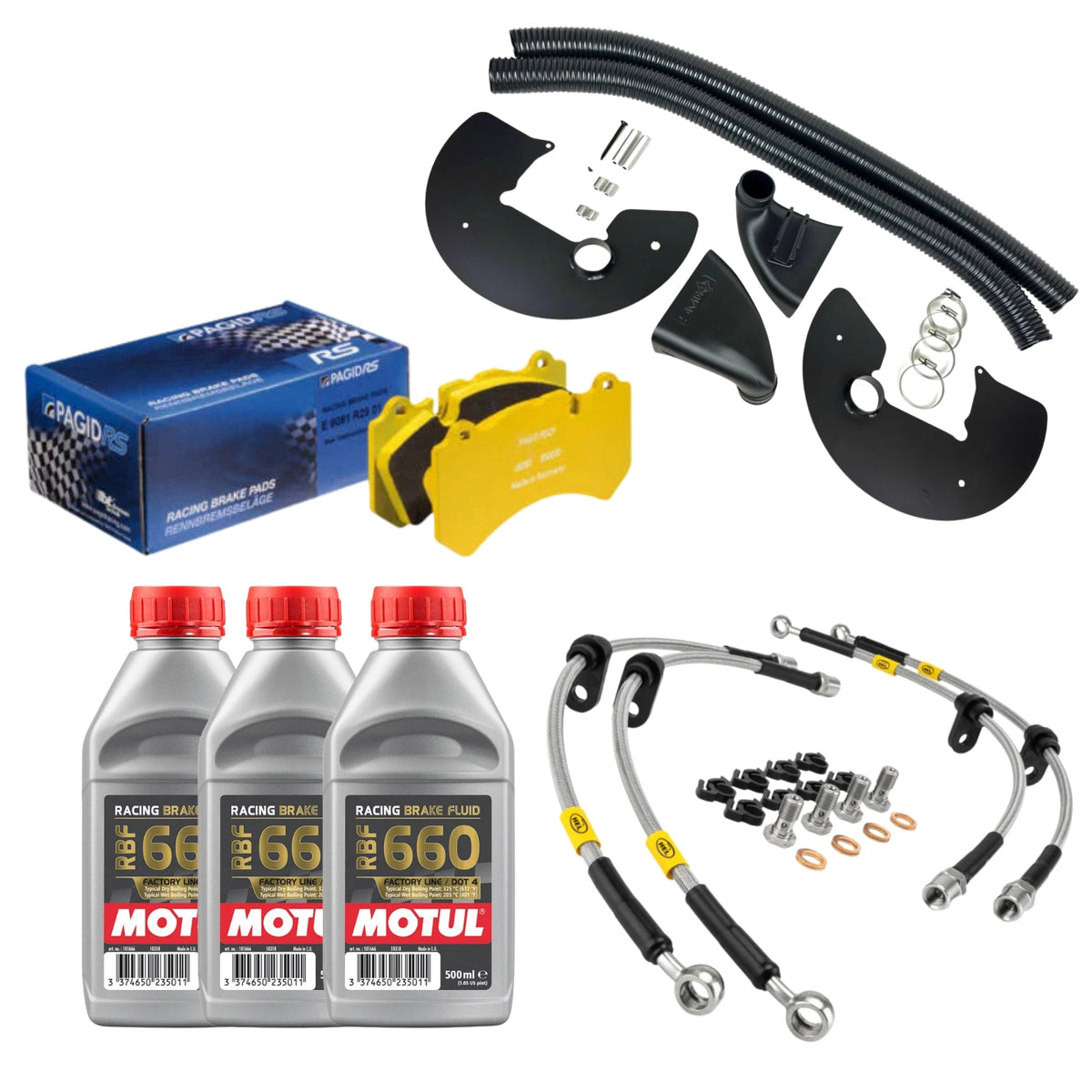
Nineteen72 Performance also supplies vehicle-specific HEL Performance braided brake lines for BMW F8X M2, M3 and M4, alongside brake packages where lines, pads and high-temperature fluid are selected as part of the complete setup.
For fluid, our Motul RBF 660 Factory Line is a popular option for demanding road and track use. The correct fluid quantity and specification should always be checked for the individual vehicle and service procedure.
So, do braided brake lines actually make a difference?
Yes, but the difference needs to be understood correctly.
Braided brake lines are primarily a pedal feel, modulation and consistency upgrade. By reducing expansion in the flexible hose, they can make the connection between your foot and the caliper feel more direct.
They are not a substitute for the correct brake pads, fresh high-temperature fluid, healthy discs, adequate cooling or good tyres. They also will not fix a braking system that already has a mechanical or hydraulic fault.
For a performance road car, they are a useful refinement. For a car that regularly sees track days, they become an increasingly logical part of a complete brake setup.
If you are unsure which brake line kit fits your car, contact Nineteen72 Performance with the registration or VIN, model year and current brake specification. We can help identify the correct application rather than guessing from the model badge alone.
Braided brake line FAQs
Do braided brake lines increase braking power?
They do not directly increase pad friction or braking torque. Their main benefit is reducing flexible-hose expansion, which can improve pedal feel and pressure modulation.
Will braided brake lines stop brake fade?
Not by themselves. Brake fade can be caused by pad temperature, fluid temperature and other thermal limitations. Braided lines address hose expansion and pedal feel rather than the temperature capability of the pad or fluid.
Do I need to change brake fluid when fitting braided lines?
The hydraulic system has to be opened and correctly bled during hose replacement, so fitting new lines is a sensible time to use fresh fluid of the correct specification. Follow the vehicle and fluid manufacturer's requirements.
Are braided brake lines suitable for daily driving?
Yes, when the kit is correctly designed and approved for the vehicle application, installed properly and maintained as part of the braking system.
Can braided brake lines make the pedal too hard?
They can make pedal response feel firmer and more defined, but they do not remove all normal compliance from the braking system. A correctly functioning system should still provide progressive control.