
BMW M Brake Caliper, Disc and Pad Fitment Guide
A practical guide to identifying common BMW M and M Performance brake packages, choosing pads for road or circuit use, understanding wear sensors and selecting suitable brake fluid.
Why BMW brake fitment is easy to get wrong
BMW often fitted more than one brake package to the same chassis. Wheel size, market, production date, M Sport brake option codes, carbon-ceramic options and factory retrofits can all change the caliper, disc and pad shape. Caliper colour helps, but it is not a reliable parts catalogue.
The correct order of identification is: VIN → factory option code → caliper type → disc diameter and thickness → pad shape and sensor arrangement. Measuring the disc is useful, but a VIN check should still be completed before supplying parts.
Common BMW performance brake systems
| Vehicle family | OEM caliper arrangement | Common iron-disc dimensions | Important fitment notes |
|---|---|---|---|
| BMW E82 1M / E90, E92, E93 M3 | OEM floating/sliding calipers; the E9X M3 is not a multi-piston fixed-caliper system | Typically 360 × 30 mm front / 350 × 24 mm rear | Confirm exact disc and pad shape by VIN. The 1M and E9X M3 share some pad applications, but do not assume every disc or sensor is shared. |
| BMW F20/F21 M135i, M140i; F22/F23 M235i, M240i with M Sport brake | Fixed 4-piston front / fixed 2-piston rear Brembo-type system | Common 340 × 30 mm front / 345 × 24 mm rear; some cars and retrofits use different front diameters | Option code and rear parking-brake drum diameter matter. Verify 02NH and chassis before ordering. |
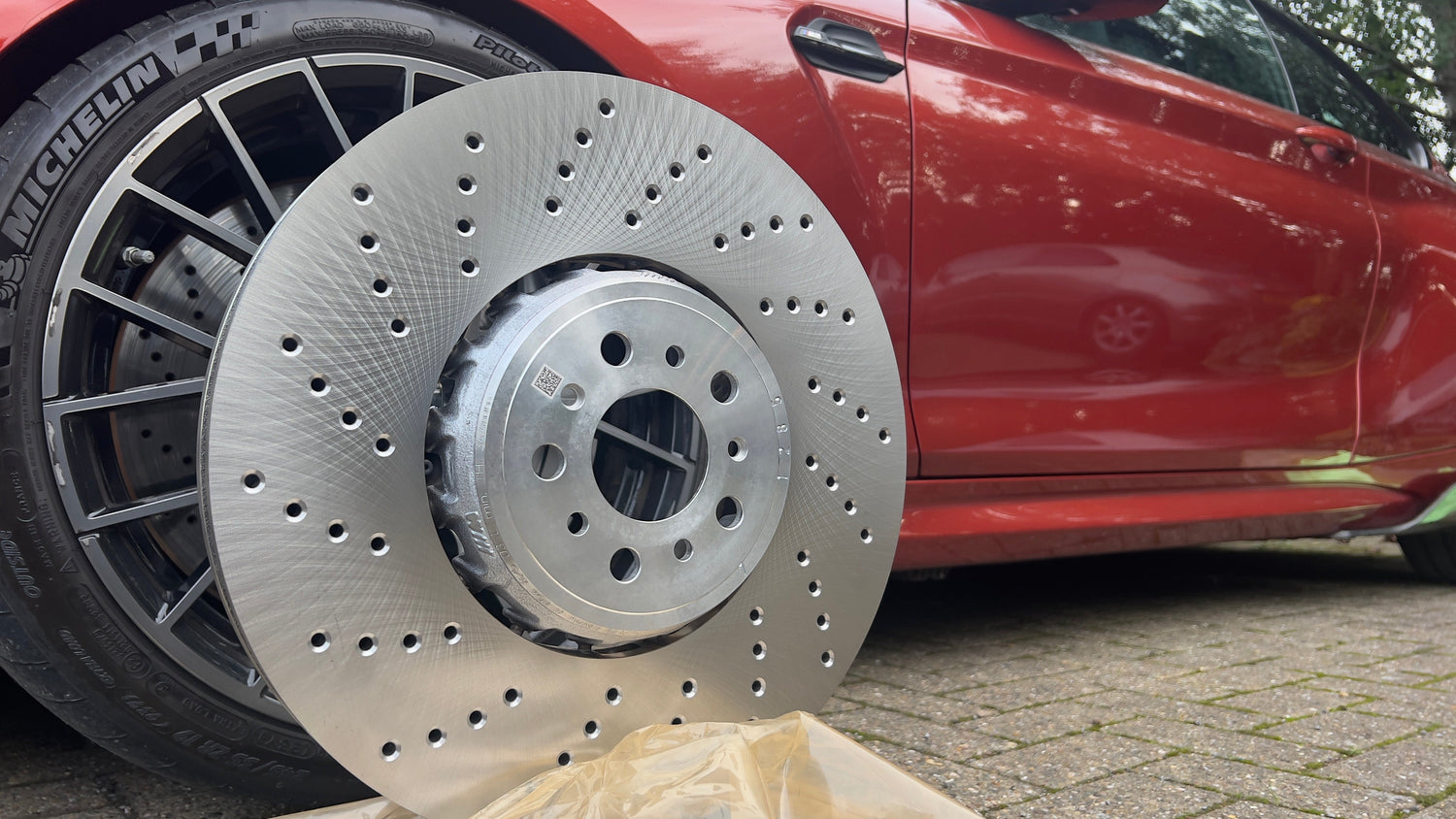
| BMW F87 M2, F80 M3, F82/F83 M4; F87 M2 Competition with standard blue brakes | Fixed 4-piston front / fixed 2-piston rear M Compound calipers | 380 × 30 mm front / 370 × 24 mm rear | The most common F8X iron-brake package. Do not confuse it with the larger 2NH M2 Competition system. |
| BMW F87 M2 Competition / M2 CS with 2NH large brakes | Fixed 6-piston front / fixed 4-piston rear | 400 × 36 mm front / 380 × 28 mm rear | Usually identified by the larger red, silver or orange calipers, but VIN and option-code confirmation remains essential. |
| BMW G87 M2, G80/G81 M3, G82/G83 M4 with M Compound brakes | Fixed 6-piston front / single-piston floating rear with electronic parking brake | 380 × 36 mm front / 370 × 24 mm rear | Do not confuse with optional M Carbon Ceramic Brake dimensions, discs or pad compounds. |
| BMW F97 X3 M / F98 X4 M | Fixed 6-piston front / floating rear | 395 × 36 mm front / 370 × 24 mm rear | BMW lists 34.4 mm front and 22.4 mm rear minimum disc thickness for the cited iron discs. |
Pad selection by intended use
Pad choice should follow the highest-temperature use the car will genuinely see, but a harder compound is not automatically better. A race pad used mostly on the road may be noisy, dusty, abrasive and inconsistent when cold. A quiet road pad may feel excellent on the first lap but overheat during repeated high-energy stops.
| Pad or compound family | Best suited to | Strengths | Limitations and legal points |
|---|---|---|---|
| Genuine BMW / OE-equivalent road pad | Road, commuting, touring | Immediate cold response, quiet operation and predictable DSC/ABS behaviour | Can overheat or wear quickly during sustained circuit laps. |
| EBC Redstuff | Fast road where a matching, approved fitment exists | Lower-dust road-biased option with civilised cold behaviour | Not the first choice for repeated heavy track use. Check exact ECE R90 status. |
| EBC Yellowstuff | Fast road and occasional light track use | Stronger temperature capability than a normal road pad | Noise, dust and wear can rise; not equivalent to a dedicated race pad. Check exact approval. |
| EBC Bluestuff | Aggressive road/track-day crossover where the exact part is road approved | High-temperature crossover compound with stronger track capability | Road legality is fitment-specific. Confirm R90 approval for the exact pad number. |
| Endless MX72 | Road-focused car that also attends track days | 50–700°C published rotor range, progressive control, designed to limit dust/noise relative to harder semi-metallic pads | A compromise: more capable than a normal road pad but not the answer for every heavy, fast or highly modified car. |
| Endless MX72 Plus | Mixed use with more sustained circuit work | 50–750°C published range and greater resistance to heat fade than MX72 | More track-biased; expect greater noise, dust and disc wear than a road pad. |
| Ferodo DS2500 | Track-day/light-race use | 0–500°C published range and average friction coefficient around 0.41 | Ferodo states it is not R90 certified and is not recommended for road use where R90 is required. |
| Pagid RSL29 | Dedicated track-day, club-race and endurance use | Excellent modulation, easy bedding and long pad/disc life | Race material: expect noise, dust and poor manners when used cold or on short road journeys. |
| Pagid RST3 | Sprint/club-race and higher-bite track use | Medium-high friction, strong initial response and low heat conductivity | More aggressive response and potentially greater wear than endurance-biased material. |
| Ferodo DS1.11 / DS3.12 | Dedicated circuit work | Published operating ranges of 200–750°C and 300–850°C respectively | Must be selected around vehicle mass, tyres, aero, driver input and rear-pad balance. |
| EBC RP-1 / RP-X | Dedicated track and race use | RP-1 is progressive; RP-X offers high 0.55 friction and full effect from cold across a published 0–750°C range | EBC states RP compounds are not R90 approved for road use in European markets. |
Recommended starting points
Road and fast-road BMW
Start with Genuine BMW or a quality road pad when the priorities are low noise, reliable cold bite, low maintenance and normal road legality. Upgrade the fluid and make sure the cooling path is unobstructed before fitting an unnecessarily aggressive pad.
Road car used for occasional track days
Endless MX72 or MX72 Plus, an approved EBC crossover compound, or another genuine road-and-track material can work well when the car is driven to the circuit. The exact choice depends on vehicle mass, tyres, pace, circuit and session length. A G80 M3 on semi-slicks requires more brake capacity than a lightly driven road-tyred M2.
Dedicated track setup
Pagid RSL29, Pagid RST3, Ferodo DS1.11/DS3.12 and EBC RP-1/RP-X are examples of circuit-focused compounds. Select front and rear compounds as a balanced system. Do not mix compounds simply because they fit the caliper: changes in friction level alter pedal response, ABS intervention and brake balance.
Brake-pad wear sensors
- Many BMWs use one electronic wear sensor on the front axle and one on the rear, not one per wheel.
- The sensor is a sacrificial part. Once it has worn through or triggered a warning, replace it.
- Some track pads have no wear-sensor slot. For a dedicated track car, the pad must then be inspected manually and the sensor strategy handled correctly by the technician.
- Never rely on the dashboard warning for track use. Measure the inner and outer pads on both sides because tapered or uneven wear can leave one pad much thinner than the visible outer pad.
Brake-fluid recommendations
| Use | Starting recommendation | Notes |
|---|---|---|
| Normal road service | Fresh BMW-compatible DOT 4 / low-viscosity DOT 4 where specified | Follow the vehicle service schedule and use the exact fluid specification required by the model. |
| Fast road and first track days | High-quality fresh DOT 4 with a strong wet boiling point | Condition matters as much as brand. Old moisture-contaminated racing fluid can be worse than fresh quality DOT 4. |
| Regular track use | Motul RBF 660, Castrol React SRF Racing or equivalent high-performance glycol fluid | Motul publishes 325°C dry / 204°C wet for RBF 660. Castrol publishes over 300°C dry and over 260°C wet for SRF. Flush thoroughly and shorten service intervals. |
Do not use silicone DOT 5 fluid. It is a different chemistry from conventional glycol-based DOT 3, DOT 4 and DOT 5.1 fluids. Fluid choice does not compensate for cooked seals, seized sliders, blocked cooling ducts or pads that are too small for the duty cycle.
Product links for common systems
- F87/F80/F82 380 × 30 mm Genuine BMW front discs
- F87/F80/F82 370 × 24 mm Genuine BMW rear discs
- F87 M2 Competition 2NH 400 × 36 mm front discs
- G87/G80/G82 Genuine BMW front discs
- G87/G80/G82 Genuine BMW rear discs
Related BMW technical guides
- Genuine BMW brake disc and pad part-number database
- BMW M2/M3/M4 track-day preparation checklist
- BMW brake-pad comparison guide
Source notes
Technical values were checked against BMW parts information, BMW owner/workshop material and the named friction or fluid manufacturer’s published data. Manufacturer temperature ranges are laboratory or product-design ranges, not a guarantee that every vehicle installation will behave identically.
- BMW Genuine Parts: F8X front pads and 380 × 30 mm disc pairing
- BMW Genuine Parts: F97 front disc dimensions and minimum thickness
- BMW Genuine Parts: F97 rear disc dimensions and minimum thickness
- Endless: MX72 technical data
- Endless: MX72 Plus technical data
- Ferodo Racing: DS2500 technical and R90 statement
- Pagid Racing: RSL29 application and characteristics
- EBC Brakes: RP-X temperature, friction and road-approval statement
- Motul: RBF 660 published boiling points
- Castrol: React brake-fluid range